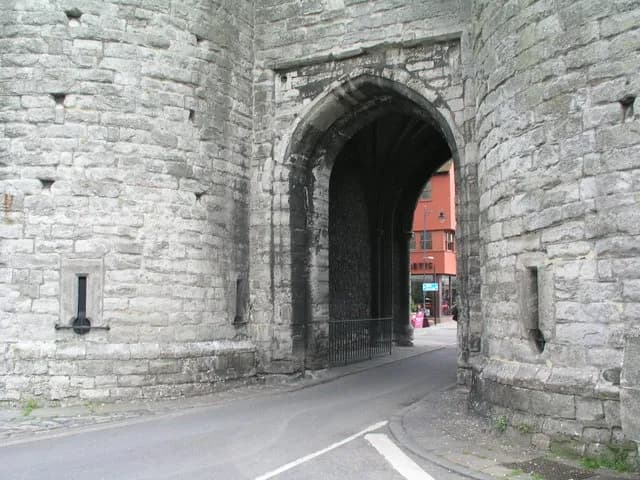
The Westgate Towers have guarded Canterbury's western approach for more than six centuries. Standing 60 feet high and built of Kentish ragstone, this formidable structure is the largest surviving medieval city gate in England, and the sole survivor of the seven gates that once punctuated Canterbury's defensive walls.
The Archbishop's Fortress
The gatehouse was constructed around 1380 under the direction of Archbishop Simon Sudbury, who served as Chancellor to Richard II. The existing Roman west gate had fallen into ruin, and Sudbury commissioned prominent mason Henry Yevele to create a replacement worthy of a major pilgrimage destination. Archaeologists Oliver Creighton and Robert Higham have described the result as "one of the most monumental of all examples of town gate architecture."
The structure's dual circular drum towers present an imposing face to approaching visitors, whilst the interior reveals a more practical square design. Eighteen gunloops were incorporated into the defences; these embrasures were among the earliest gunports in Britain and represent a sophisticated evolution in military architecture. The angles were carefully calculated to create a battery of covering fire, similar to the design at Cooling Castle.
Four Centuries Behind Bars
In 1453, Henry VI granted permission for the Mayor and Commonality to establish a prison within the gatehouse. For nearly 400 years, the Westgate served as Canterbury's city jail, housing debtors and criminals whilst Canterbury Castle accommodated county prisoners. The room above the arch became the condemned cell, with the portcullis laid across the floor as a grim reminder of the building's defensive origins. Until 1775, a grated cage in the prison gateway allowed certain inmates to beg alms from sympathetic passers-by.
The conditions eventually drew criticism from prison reformers. By the 19th century, the jail was condemned as dirty, cramped, and insecure. It closed in 1865. The adjacent jailer's house, built between 1823 and 1829, now serves as a bar and cafe; the dining room retains the name "The Parade Room."
The Sudbury Legacy
The archbishop who built the Westgate met a violent end. In 1381, during the Peasants' Revolt, Simon Sudbury was dragged from the Tower of London and beheaded with eight sword blows. His head was nailed to a pole on London Bridge; it was later removed and taken to Sudbury, where it remains preserved at St Gregory's Church. His tomb at Canterbury Cathedral lacks its occupant's skull. By ancient tradition, the Mayor of Canterbury places a wreath of red roses on Sudbury's tomb each Christmas Day.
Close Calls and Hidden Treasures
The Westgate has survived several threats to its existence. During the English Civil War, Parliamentarian forces burnt the wooden doors of all city gates in January 1648; replacements were not installed until after the Restoration of Charles II in 1660. In 1859, the Wombwell Circus sought permission to demolish the gate to allow elephants to parade into the city; the structure was saved by the mayor's casting vote.
In 1906, the gatehouse opened as a museum. Its collections include seventeen six-foot painted plaster maquettes of Magna Carta barons, created between 1847 and 1851 as models for bronzes in the House of Lords. Fourteen of these maquettes were forgotten in the north tower basement from 1987 until their rediscovery in May 2008, following a flood that damaged many of them.
A Living Monument
Today the Grade I listed building and scheduled monument houses the West Gate Towers Museum alongside escape rooms and a cafe. Visitors can explore three floors, including the roof walkway with its battlemented parapet, and examine exhibits ranging from English Civil War armour to a World War II Civil Defence display. The gatehouse continues to straddle the main road into Canterbury, a working piece of medieval engineering that still serves its original function whilst welcoming modern pilgrims through its vaulted passage.