For more than two centuries, Canterbury served as England's principal sanctuary for French Protestant refugees, who brought with them skills that would utterly transform the city's economy and identity.
The First Refugees Arrive
The Huguenot presence in Canterbury began as early as 1548, when Jan Utenhove, a scholar from Strasbourg, established the first French Protestant church in the city alongside Valérand Poullain and François de la Rivière. This initial settlement was short-lived; the accession of Mary I in 1553 compelled the congregation to flee to continental cities including Geneva, Strasbourg, and Basel.
The permanent Huguenot community took root following the St. Bartholomew's Day Massacre of 1572, which triggered a significant wave of refugees. In late 1574, eighteen Huguenot families led by Hector Hamon, a minister from Bacqueville in Normandy, entered Canterbury from the coastal towns of Rye and Winchelsea. A larger migration followed in June 1575, when approximately one hundred Walloon families from Sandwich relocated to Canterbury with permission to manufacture textiles "according to the methods of Flanders, not England."
A City Transformed
The demographic impact was profound. By 1597, the Huguenot congregation numbered 2,068 men, women, and children. Within decades, French-speaking refugees comprised two-fifths of Canterbury's total population.
The refugees transformed Canterbury from a declining medieval wool town into England's silk capital. The original 1574 settlers were skilled weavers of serge, taffeta, and bombazine. The 1575 arrivals brought expertise in wool-weaving, woolcombing, spinning, and dyeing, producing baize, saye, and passementerie using Continental techniques previously unknown in England.
By 1676, silk weaving had outstripped wool weaving as Canterbury's dominant industry. The Privy Council intervened on several occasions to protect Huguenot weavers when they faced attacks from local competitors envious of their success.
Worship in the Crypt
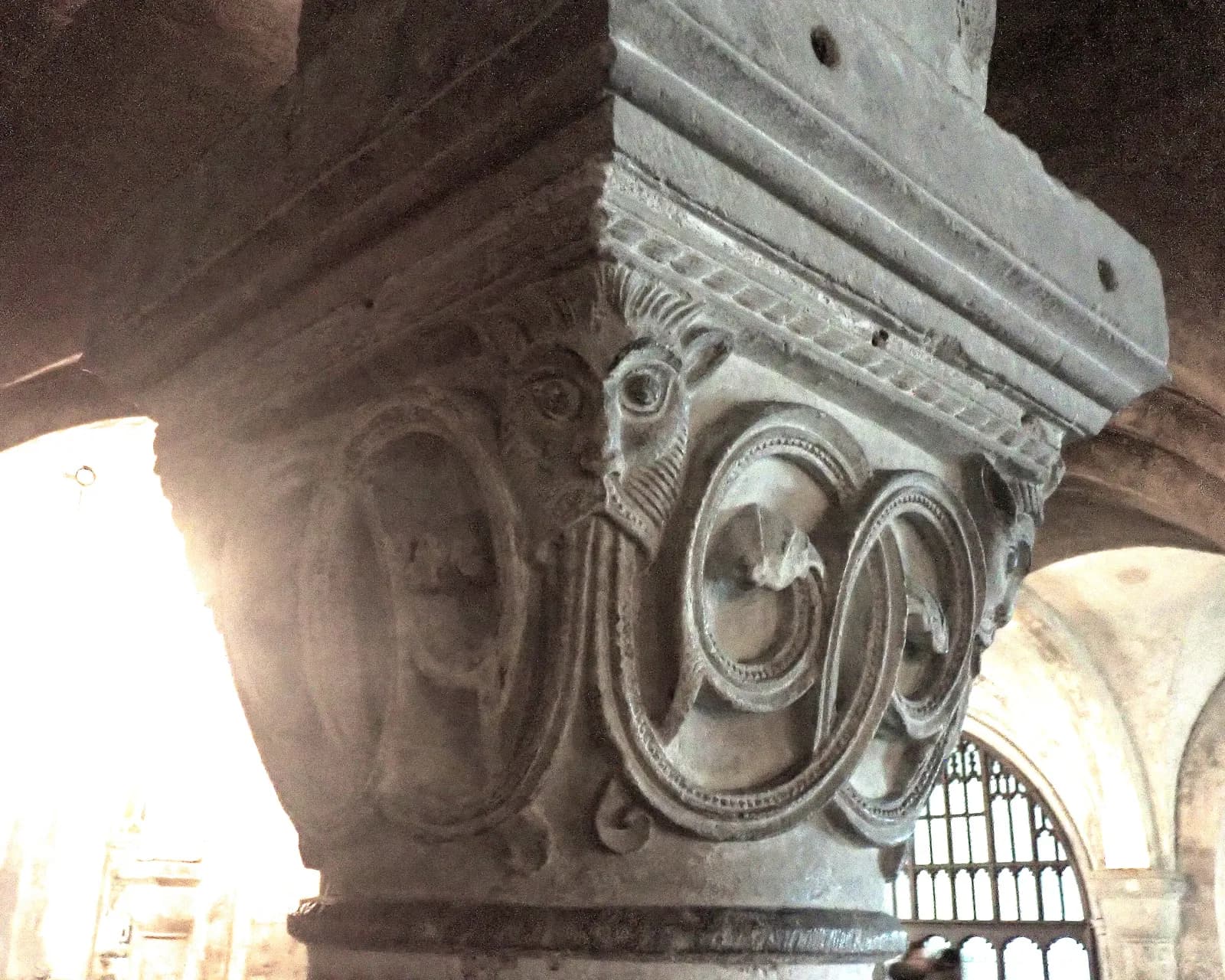
Religious life centred on two remarkable locations. St Alphege Church was granted to the Huguenots in early 1575 for worship. In 1576, the community moved to the crypt of Canterbury Cathedral, which became the nucleus of their religious and social life. This arrangement continued for centuries, and the French Protestant Church of Canterbury still meets in the Black Prince Chantry within the Cathedral today.
The Huguenots governed themselves through a Consistory, dividing the city into four quarters for administration and electing elders and deacons annually. This structure operated as what historians describe as a "small religious republic modelled after Geneva."
Silk, Decline, and Lasting Heritage
The silk industry that the Huguenots established dominated Canterbury's economy for generations. However, by 1820, the trade had succumbed to competition from imported Indian muslins. Canterbury's silk industry ceased entirely in 1837, giving way to commerce based on hops and wheat.
Physical traces of the Huguenot era remain visible throughout Canterbury. The Old Weavers House, a surviving Huguenot building, stands as a tangible reminder of the refugee weavers who once worked there. Huguenot weavers' houses near the High Street also survive, their architecture reflecting the period when French artisans transformed the city's streetscape.